May 13, 2026
Why Every Building Is Guessing About Energy
A practical look at why the energy transition is being held back by a data problem, and what smart companies are doing about it
The Door Nobody Should Be Knocking On
Every year, thousands of sales teams fan out across cities with solar proposals, portfolio risk reports, and renovation pitches.
Most of them are guessing.
They don't know if the roof faces the right direction. They don't know how much shade hits it at 2pm in January. They don't know what the building next door is doing, or what the grid capacity looks like three blocks over.
They have business cards and optimism. That's about it.
And yet — some companies aren't guessing. They're winning. They're building lead lists that actually convert. They're screening portfolios in days instead of months. They're identifying the three buildings in a city that actually need priority renovation right now.
The difference isn't better salespeople. It's better data.
The Problem Isn't a Data Shortage — It's a Connection Shortage
Here's what most people miss: the data already exists.
Satellite imagery is everywhere. Building footprints are digitized. Census demographics are public. GIS layers map utilities, zoning, and infrastructure. Energy consumption figures are logged somewhere.
The problem is that nobody has connected them into a single decision system. They live in different formats, different platforms, different organizations — and almost never talk to each other.
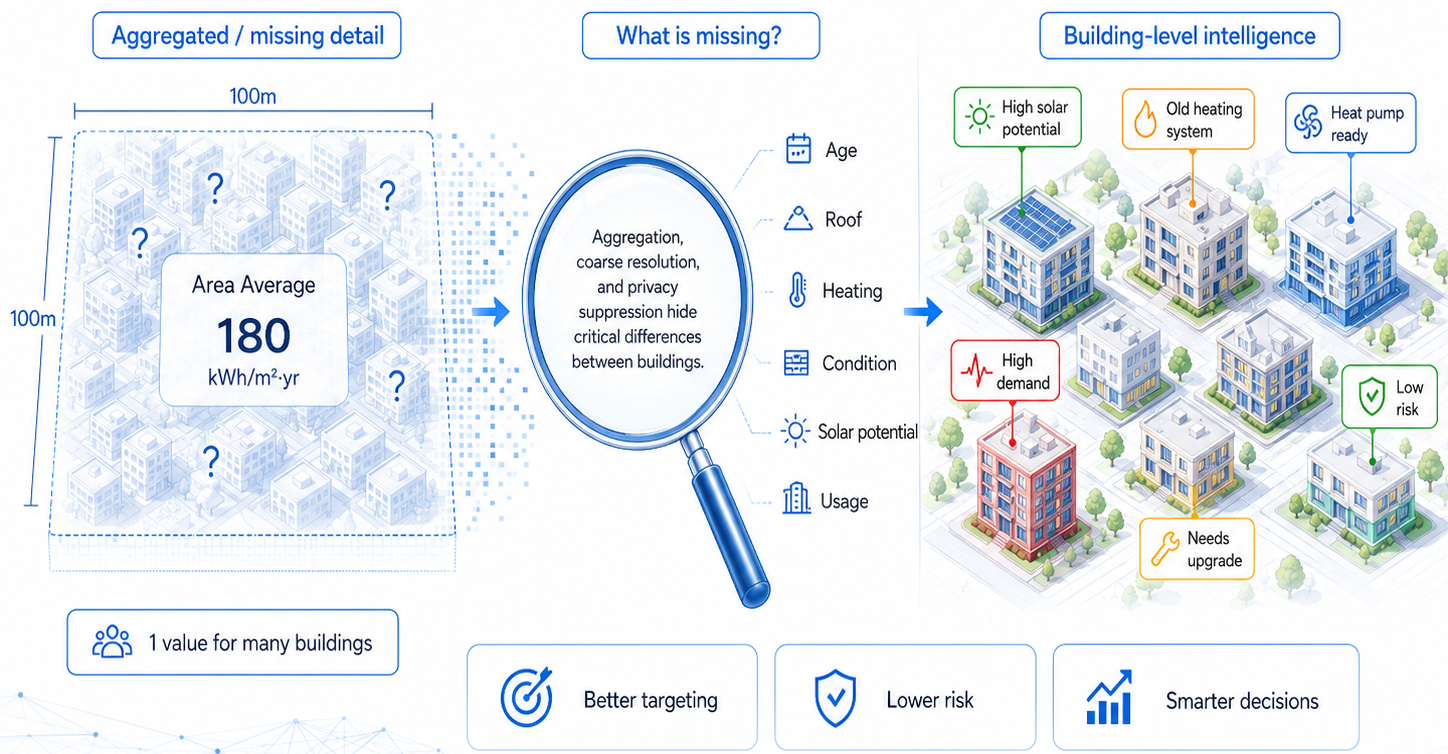
The EU's own research confirms this. Their MODERATE project — an initiative to build a pan-European building energy data marketplace — exists precisely because operational building data is fragmented across proprietary silos, incompatible formats, and organizational boundaries. [1]
It's a coordination problem wearing a technology costume.
What the Data Fragmentation Actually Costs
Let's be concrete. Here's what's happening when data stays siloed:
Problem | Real Consequence |
|---|---|
Solar companies can't prioritize rooftops | Field sales waste time on bad leads — estimates suggest cold-call conversion rates in rooftop solar often fall below 5% |
Real estate funds can't assess energy risk | Banks and investors using ECB climate stress tests face incomplete asset-level data, making portfolio risk assessments unreliable [2] |
Cities can't plan heat demand | Municipal heat plans miss concentration zones because granular building-level energy data simply doesn't exist for most urban areas |
Consultants deliver slow, expensive reports | Manual data gathering can add weeks to building energy assessments — time that clients don't want to pay for and can't afford to wait |
These aren't hypothetical risks. They're daily operational realities.
The Spatial Intelligence Stack
So what does a smarter approach look like?
Over the past few years, a pattern has emerged among the companies winning with building data. It's not complicated — but it is a workflow:
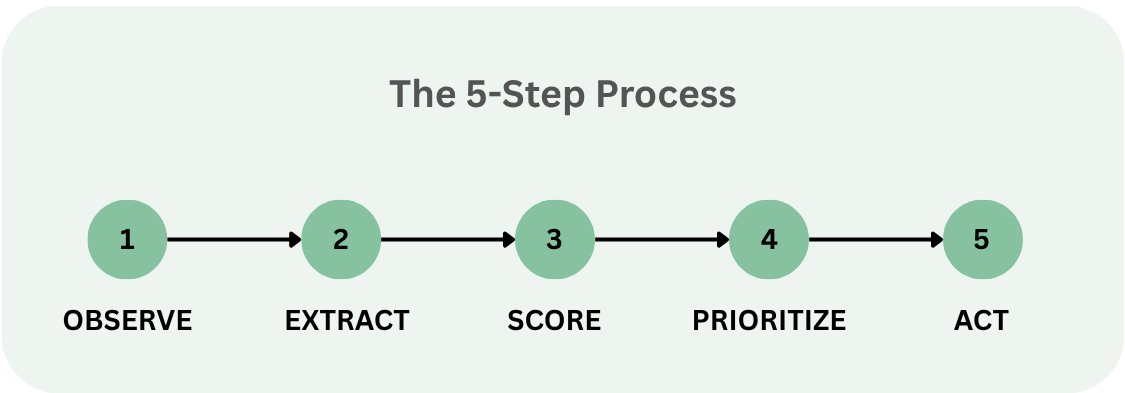
1. Observe — Pull satellite imagery, aerial photography, and GIS layers to map what's there: buildings, trees, nearby structures, shading obstacles.
2. Extract — Use AI models to derive building-level signals: roof pitch, roof area, orientation, shade coverage, proximity to infrastructure.
3. Score — Apply domain logic to rank buildings by solar potential, renovation urgency, heat demand, or energy risk. This turns raw signals into business-relevant indices.
4. Prioritize — Sort by opportunity score. One building at the top of the list is worth ten at the bottom.
5. Act — Route prioritized leads to sales teams, analysts, or city planners. Or automate the next step entirely.
This isn't theoretical. Google is already running a Solar API that provides building-level solar potential estimates via satellite imagery at scale. [3] The EU Joint Research Centre has mapped rooftop PV potential for the entire continent. [4] And commercial geospatial AI platforms are growing fast — the rooftop solar mapping market alone is projected to grow from $425M in 2024 to $1.67B by 2033. [5]
The Business Case Is Closing Fast
Here's what should matter to executives, investors, and operators:
The solar AI market is growing at 20.8% CAGR.[6] The market for rooftop solar potential mapping via satellite is growing at 16.4% CAGR.[5] These aren't niche indicators — they're signals that somebody is paying for this, at scale, and getting return on it.
Real estate is waking up too. GRESB — the ESG benchmarking standard used by major institutional investors — has made energy data coverage a scoring factor. That means portfolios with better data perform better with the investors who allocate capital. [7]
And cities are mandating it. EU regulations call for 55% of energy savings by 2030 to come from renovating the worst-performing buildings. But you can't renovate what you can't rank — which means building-level data is becoming a regulatory requirement, not just a nice-to-have.
What You Can Do With It
If you're a solar installer or PV company: AI-scored rooftops give you a lead list with conversion rates that don't require cold-calling the entire city. Prioritize by solar yield. Knock on the doors that actually make sense.
If you're a real estate fund or property owner: Energy risk scores let you screen portfolios in a morning instead of a quarter. Identify the three assets that need urgent attention — before your investors ask.
If you're a municipality or city planner: Heat demand maps at building resolution let you write heat transition plans that target concentrations, not guess at neighborhoods. The EU wants this. Your constituents need it.
If you're an energy consultant: You can deliver reports faster when the data assembly is automated. Turn a two-week engagement into a two-day one — and take on twice as many clients.
This Isn't a Tech Story. It's a Decision Story.
Spatial intelligence isn't about satellites or machine learning or fancy dashboards. It's about one thing: making better decisions faster.
Right now, most energy decisions are still made on spreadsheets, intuition, and incomplete maps.
The companies and cities that connect their data — and learn to score, rank, and prioritize — will make better decisions. They'll move faster. They'll win more of the right opportunities.
The rest will keep knocking on doors they shouldn't be at.
Sources
[1]: EU BUILD UP — "Data Silos in Smart Energy Management for Buildings" (MODERATE Project) — https://build-up.ec.europa.eu
[2]: ECB Banking Supervision — "Climate-Related Data for the Real Estate Sector: Challenges and Opportunities" (Nov 2024) — https://www.bankingsupervision.europa.eu/press/pr/241113_34/html/index.en.html
[3]: Google Research — "Satellite-Powered Estimation of Global Solar Potential" (Dec 2024) —https://research.google/blog/satellite-powered-estimation-of-global-solar-potential/
[4]: EU Joint Research Centre — "Mapping Europe's Rooftop Photovoltaic Potential with a Building-Level Database" (Jan 2026) — https://joint-research-centre.ec.europa.eu
[5]: Market Intelo — "Global Rooftop Solar Potential Mapping via Satellite Market Report" (Sept 2025) —https://marketintelo.com/report/rooftop-solar-potential-mapping-via-satellite-market
[6]: Grand View Research — "Solar AI Market Size & Share Analysis" (2024) —https://www.grandviewresearch.com/industry-analysis/solar-ai-market-report
[7]: GRESB — "From Fragmented to Unified: How Real Estate Can Achieve 100% Energy Data Coverage" (Apr 2025) — https://www.gresb.com/nl-en/from-fragmented-to-unified-how-real-estate-can-achieve-100-energy-data-coverage/