May 22, 2026
How Geospatial AI, Vision Models, and LLMs Are Reshaping Solar Installation
The solar industry is in the middle of a quiet revolution. Not in the panels themselves, but in how installers find customers, assess rooftops, design systems, and close deals.
The Old Way Is Bleeding Money
A traditional solar installation workflow is slow and expensive. A sales rep drives to a site, assesses the roof manually, takes photos, goes back to the office, runs the design in CAD software, writes a proposal, and sends it to the customer — often days later. Meanwhile, the lead has gone cold.
The numbers are stark:
A manual site assessment and proposal takes 3+ hours on average
Traditional yield estimates are accurate to only ~75%
Most installers spend 30–40% of operational costs on activities that AI can now automate
The industry is projected to grow from $5.96 billion in 2024 to $18.43 billion by 2030. The installers who automate fastest will take the lion's share of that growth.
What Geospatial AI Actually Does
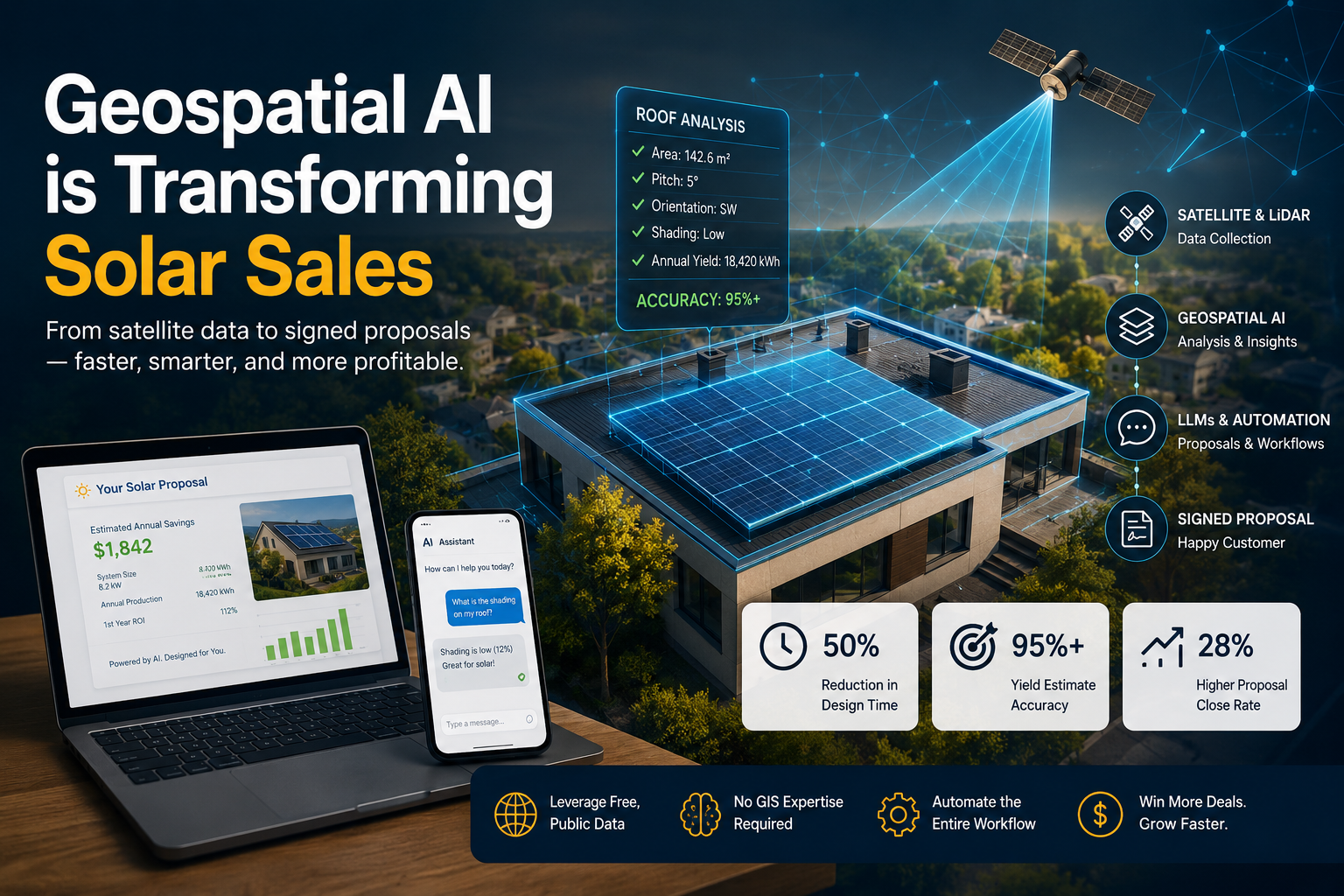
Geospatial AI combines satellite imagery, LiDAR (laser distance scanning), and GIS data to analyze rooftops — automatically, remotely, and at scale.
Without anyone visiting the site, it can:
Measure roof dimensions — exact area, pitch, and orientation
Run 3D shading analysis — how much sun each section of the roof receives across all seasons
Detect obstacles — vents, chimneys, skylights, dormers
Calculate annual yield estimates — accurate to 95%+
Real-world deployments show a 50% reduction in design time and 15–25% higher energy output through better panel placement. That's not theoretical — tools like Aurora Solar and EasySolar are already delivering these results in production.
The data behind the analysis
Data Input | What It Reveals | Installer Benefit |
|---|---|---|
Satellite imagery | Roof area, orientation, condition | Pre-qualify leads remotely |
LiDAR | 3D roof model, pitch angles | Accurate system sizing |
Solar radiation data | Annual yield in kWh | Realistic customer proposals |
Shading analysis | Monthly sun exposure | Optimal panel placement |
Historical weather | Temperature & precipitation impact | Reliable performance predictions |
Vision Language Models: Asking Questions of an Image
VLMs are AI systems that understand both images and natural language — so you can ask a satellite image a question and get a useful answer.
For solar installers, this means no GIS expertise required. You can simply query:
"Identify all flat roofs suitable for solar in this postcode area"
"What is the shading profile of this building across seasons?"
"Detect existing solar panels on nearby buildings"
"Compare roof conditions across my sales territory"
The results are serious. A WRI pilot in Kenya using YOLOv8 object detection achieved 94% accuracy detecting solar panels from satellite imagery and identified 274 rooftop PV systems in the initial pilot area — automatically, without any manual surveys.
This matters for lead generation. Instead of cold-calling entire neighborhoods, an installer can use VLM-powered territory analysis to identify which buildings are the best candidates, filter by roof quality, flag where competitors have already installed, and prioritize accordingly. That's a fundamentally different (and far more efficient) sales motion.
LLMs: The Business Automation Layer
While Geospatial AI and VLMs handle the spatial and visual side, LLMs handle everything downstream — the business operations layer.
Function | LLM Application | Impact |
|---|---|---|
Customer service | 24/7 chatbots answering solar questions | Faster lead qualification |
Proposal generation | Auto-create proposals from site data | 5-minute quotes vs. 3 hours |
Document processing | Extract data from permits, utility bills | Faster admin work |
Sales analytics | Interpret customer data patterns | Better lead scoring |
Technical support | Guide field technicians | Reduced troubleshooting time |
Energy advisory | Explain solar benefits to homeowners | Higher conversion rates |
The proposal automation finding is striking: AI-generated proposals that pull in real-time equipment pricing, local incentives, and utility rates close 28% better than traditional proposals. A research study on LLM-based home energy management interfaces showed 88% parameter accuracy, confirming these systems are mature enough for customer-facing deployment.
Modern LLM platforms also integrate with CRMs — automating follow-ups, personalizing outreach, and predicting conversion likelihood without manual input from the sales team.
The Data Sources: Most Are Free
One underappreciated point: the majority of the data powering these systems is publicly available.
Free sources:
PVGIS — Global solar radiation data, API access, excellent EU coverage
Google Project Sunroof — US and select international rooftop-level analysis
Sentinel-2 / Copernicus — EU satellite imagery at 10m resolution
OpenStreetMap — Global building footprints with roof shape attributes
Cadastral registries — Government land records, permit histories, zoning data
Paid (when you need precision):
Commercial satellite imagery at sub-50cm resolution for high-stakes assessments
A 2023 Nature Energy study used European building-level databases to find that EU rooftops could meet 40% of the bloc's long-term electricity demand — a number made possible only by combining these datasets at scale. That same methodology is now accessible to any installer with the right tools.
The Tools That Deliver This Today
Platform | Strengths | Best For |
|---|---|---|
Aurora Solar | Full design-to-proposal, AI optimization | Enterprise installers |
OpenSolar | Free designer, integrated CRM, equipment marketplace | All sizes (start here) |
EasySolar | AI + geospatial data combined, lead generation focus | Lead conversion |
SiteCapture | Field photos → automated designs | Field-heavy operations |
Arka360 | 3D design, proposal automation, CRM | Mid-sized installers |
Fieldproxy | Quote automation: 4.5-minute quotes at 99.2% accuracy | High-volume operations |
PVGIS | Free solar radiation modeling | Any installer, starting point |
The Window for Early Movers Is Open — But Not Forever
The AI tools described here are not hypothetical. They are deployed, proven, and in many cases free to start using today. The installers who integrate them into their workflows over the next 12 months will gain structural advantages in speed, accuracy, and cost efficiency that will compound over time.
Customer expectations are rising. When one installer can deliver a 5-minute, photorealistic, accurate proposal and another takes three days, the outcome is not a coin flip.
The question for solar businesses right now is not whether to adopt these tools. It's how fast.
This article is based on a deep research report synthesizing 12 sources including academic research (Nature Energy, arXiv), commercial tool analysis, and field deployment data from projects including WRI Kenya's AI solar mapping pilot.